

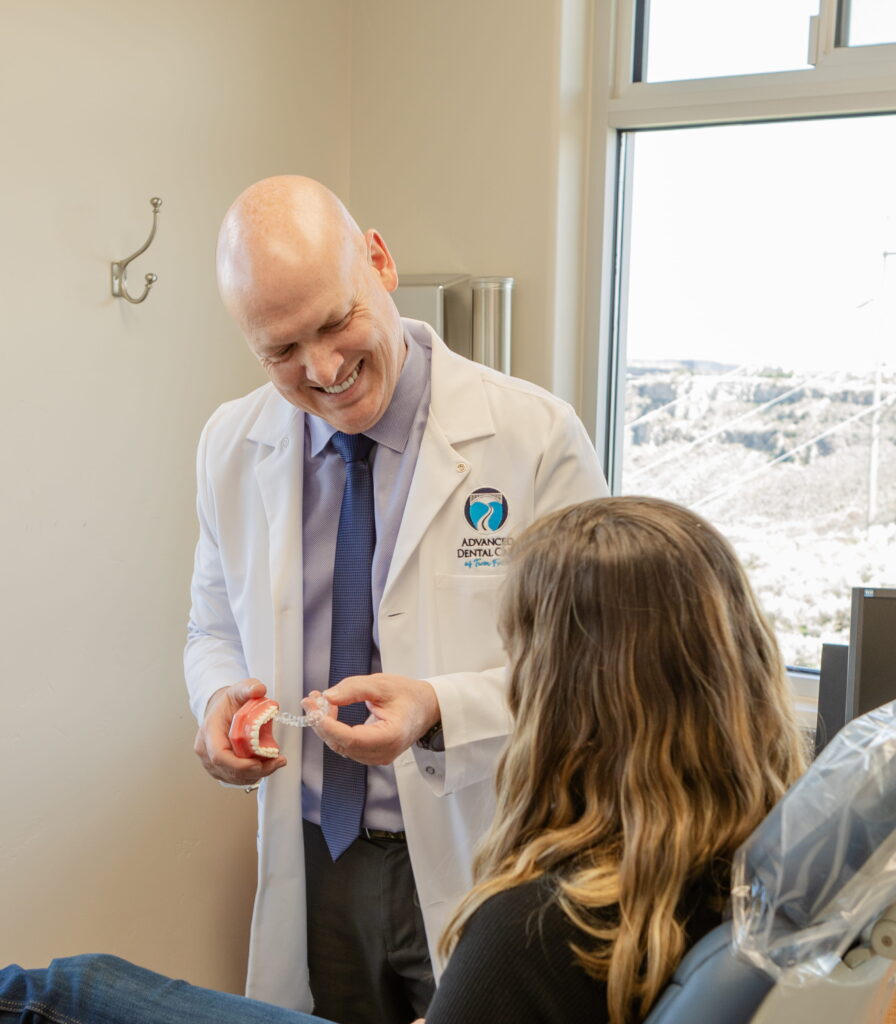
| Quick answer
Before approving Invisalign, your dentist checks your oral health, gum condition, bite, and alignment, and reviews digital scans and X-rays to confirm clear aligners can move your teeth safely and predictably. |
| 24 hours
Daily Invisalign wear time |
4 steps
Approval review process |
(208) 734-8080
Call to book a visit |
Key takeaways
|
What Your Dentist Checks Before Approving You for Invisalign at Advanced Dental Care of Twin Falls
Before approving you for Invisalign, your dentist checks four main things: the health of your teeth, the condition of your gums, your bite and alignment, and detailed digital scans and X-rays. These checks confirm that clear aligners can move your teeth safely and give you the result you want. At Advanced Dental Care of Twin Falls, this review happens during your first visit, so nothing is left to guesswork.
The quick checklist of approval factors
- No active cavities or untreated decay
- Healthy gums with no active gum disease
- A bite problem that aligners can correct
- Clear digital scans and X-rays for planning
- A commitment to wearing trays as directed
Why a thorough exam matters for predictable results
A careful exam protects your investment and your smile. Research shows that aligner success depends heavily on proper case selection and planning, which is why Dr. Brian Rencher reviews each detail before you begin. You can read more about the factors that influence results in this systematic review on the predictability and success of Invisalign aligners, which explains why thorough evaluation matters so much for a smooth outcome.
Oral Health Screening Before Invisalign
The first thing your dentist checks is your overall oral health, because aligners should never move teeth that are not healthy to begin with. If any problems appear, they are handled before treatment starts.
Checking for cavities and active decay
Your dentist looks for cavities and soft spots on each tooth. Moving a tooth with untreated decay can make a small problem worse, so any cavities are repaired first. This simple step keeps your teeth strong throughout treatment.
Gum health and periodontal evaluation
Healthy gums are the foundation for moving teeth. Your dentist examines your gum tissue for swelling, bleeding, or signs of disease. If your gums need attention, that care comes first so your teeth sit in a stable, healthy environment.
Why healthy gums support successful tooth movement
Teeth move through the bone and tissue that hold them in place, so that tissue must be in good shape. When your gums are healthy, movement is smoother and more comfortable. Daily cleaning habits matter here, and the American Dental Association guide to home oral care offers helpful habits for brushing and flossing that keep gums ready for treatment.
Evaluating Your Bite and Alignment Issues
Next, your dentist studies how your teeth fit together and how they are positioned. This tells them whether clear aligners are the right tool for your smile.
Crowding, spacing, and rotation
Your dentist measures crowding, gaps, and rotated teeth. Mild to moderate cases often respond very well to aligners. If you want to see how crowding is handled, our guide on how Invisalign fixes upper teeth crowding walks through the process in plain language.
Open bite, overbite, and crossbite considerations
Bite problems such as an open bite, overbite, or crossbite are also reviewed. Many of these respond to aligners, while a few more complex cases may need extra planning. Correcting your bite does more than straighten your smile. You can learn why in our article on how Invisalign treatment improves your smile and health, which connects a balanced bite to easier chewing and cleaning.
Cases that are well-suited for clear aligners
Clear aligners work best for people with mild to moderate alignment and bite concerns. To see if your situation fits, review these 5 signs you’re a good candidate for Invisalign, which gives a friendly overview of who tends to do well with treatment.
Digital Scans, X-rays, and Treatment Planning
Your dentist then captures digital scans and X-rays to build a precise plan. This is where your future smile starts to take shape on screen.
How digital impressions map your smile
A small handheld scanner creates a detailed, comfortable image of your teeth without messy molds. This picture becomes the map for every stage of movement.
Accuracy of intraoral scanning for planning
Digital scanning is known for its accuracy, which helps your trays fit well and track movement closely. A systematic review on the accuracy of dental scanning supports how reliable these modern scans are for building a dependable plan.
What Dr. Brian Rencher reviews in your 3D plan
Dr. Brian Rencher studies your 3D plan to confirm the order of movements, the expected timeline, and the final position of each tooth. This review lets you preview your result before your first tray is ever made.
A note from Dr. Brian Rencher“My goal is for every patient to feel confident before we begin. When I review your scan at Advanced Dental Care of Twin Falls, I am mapping each step so your treatment is predictable and comfortable from day one.” |
What Could Disqualify You From Invisalign
A few conditions can delay approval, but most are temporary and fixable. The goal is always to prepare your mouth so aligners can succeed.
Untreated decay or gum disease
Active cavities or gum disease will pause the process. Once these are treated, you can usually move forward with your plan.
Severe skeletal or complex bite problems
Some complex skeletal or bite problems may need added planning or a combined approach. Your dentist will explain your options clearly so you know what to expect.
How these issues are addressed before starting
Most concerns are solved with routine care first.
Helps approval
|
Delays approval
|
What Makes a Good Invisalign Candidate
A good candidate combines a healthy mouth with steady daily habits. Your attitude and routine matter as much as your bite.
Commitment to wearing aligners consistently
Aligners should be worn close to 24 hours a day to stay on track. Consistent wear is the single biggest factor you control, and it keeps your timeline moving.
Good daily oral hygiene habits
Brushing and flossing each day keeps your teeth and trays clean. Strong habits help your gums stay healthy throughout the entire process.
Realistic expectations about treatment
Great candidates understand that progress happens gradually, one tray at a time. Knowing what to expect makes the journey smoother and more rewarding.
The Advanced Dental Care of Twin Falls Approach to Invisalign
Our approach is built around comfort, personal attention, and a smarter way to wear your trays. This is what sets Advanced Dental Care of Twin Falls apart for local families.
Mentorship and patented technology
Dr. Brian Rencher brings special mentorship and patented technology developed with Dr. Galler. This combination gives patients a more comfortable and convenient experience than many expect from clear aligners.
Eating comfortably with your trays in
At Advanced Dental Care of Twin Falls, we have our patients eat with their trays in. This simple difference makes daily life easier and keeps your treatment on schedule without interrupting your meals.
Personalized planning for Twin Falls patients
Every plan is tailored to your smile, your goals, and your daily routine. You are never treated like a number, and Dr. Brian Rencher personally guides your care from start to finish.
What to Expect After Approval
Once you are approved, treatment follows a clear and simple rhythm. Here is how the first steps usually unfold.
|
Receiving your first alignersYou pick up your first trays and learn how to seat and remove them properly. Your dentist confirms the fit before you leave. |
|
|
Progress check-ups and aligner changesYou switch to a new set on schedule and visit for brief check-ups. Learn more about how often you change Invisalign aligners so you always know what comes next. |
|
|
Caring for your aligners day to dayKeep your trays clean and store them safely when needed. For simple routines, see these Invisalign care tips from Dr. Brian Rencher. |
With steady wear and regular visits, your smile steadily moves toward your goal. If budget is on your mind, our guide to finding affordable Invisalign near you offers practical ideas for every situation.
Simplifying Dental Costs with Our Membership Plan
Many patients feel unsure about dental insurance. To make things easier, we offer a simple alternative.
At Advanced Dental Care of Twin Falls, our Membership Plan removes the complexity of traditional insurance.
Membership Options
- Child Complete – $22 per month or $264 per year
- Adult Complete – $33 per month or $396 per year
- Perio Maintenance – $63 per month or $756 per year
Benefits include cleanings, exams, routine X-rays, and discounts on treatment. There are no deductibles, no yearly maximums, and no claim denials.
This allows you to focus on maintaining healthy habits throughout your Invisalign journey.
What Patients Are Saying
We are proud to maintain a 5-star reputation in the Magic Valley community.
Read patient experiences on our Reviews page or share your own feedback through Share Your Reviews.
Planning Your Visit
- Contact us through our Contact Us page
- Start with your consultation with Dr. Brian Rencher
- Prepare by reviewing Your First Visit
- Plan your route with Get Directions
- Get directions using Google Maps
Meet Dr. Brian Rencher
For Dr. Brian Rencher, dentistry runs in the family. A Twin Falls native, he practiced alongside his father for 18 years before his father’s retirement in 2019, and he’s carried that same commitment to patient care forward ever since. Today he brings his expertise in cosmetic dentistry, Invisalign, and implants to every visit, always with a personal touch.
His path took him through Idaho State University for his bachelor’s degree and the University of Louisville for his Doctorate in Dental Medicine. Along the way, he served an LDS mission in Chile and came home fluent in Spanish, a skill he still uses to connect with patients today. He and his wife, Jodie, married in 1995 and now have four kids: Madison, Dalton, Meigan, and Meilin.
In 2024, Dr. Rencher was named an AACA Fellow, an honor held by fewer than 100 dentists worldwide. He’s also led humanitarian dental trips abroad and volunteers with Special Olympics, Give Kids a Smile, and Boy Scouts of America. Through Dentistry from the Heart, he and his team provide thousands of dollars in free dental care to the local community.
Outside the practice, he’s usually outdoors: skiing, playing soccer, boating, or spending time with his kids. That same energy shows up in the practice he and Jodie have built, one where patients and team members feel right at home.
Frequently asked questions
| Q: What disqualifies you from Invisalign?
Untreated cavities, active gum disease, and certain severe skeletal or complex bite problems can delay approval. Most of these are temporary. Once cavities are repaired and gums are healthy, many patients can move forward with their plan at Advanced Dental Care of Twin Falls. |
| Q: Is it hard to get approved for Invisalign?
For most people with mild to moderate alignment and bite concerns, approval is straightforward. Your dentist simply checks your oral health, bite, and digital scans. If a minor issue appears, it is usually treated first, and then you can begin. |
| Q: What I wish I knew before getting Invisalign?
Many patients wish they had known how important consistent wear is. Wearing your trays close to 24 hours a day keeps your timeline on track. Good daily brushing and flossing, and keeping your check-ups, also make the whole experience smoother and more predictable. |
| Q: How long does Invisalign treatment take at Advanced Dental Care of Twin Falls?
Treatment timelines depend on your smile, but trays are worn about 24 hours a day for the best progress. Dr. Brian Rencher reviews your 3D plan to estimate your timeline during your consultation so you know what to expect. |
Remember: That approval protects your smile, and a healthy mouth plus consistent wear leads to the best results at Advanced Dental Care of Twin Falls.
Disclaimer: This article is for general information only and does not replace a personal exam or advice from Dr. Brian Rencher. Please call (208) 734-8080 to discuss your specific needs.